SEO vs Google Ads: where should a small budget go?
Ads bring visitors today and stop the moment you stop paying. SEO is slow but keeps working. For a small business the right answer is rarely all one or the other. Here is how to decide.
If you have ₹20,000 a month for marketing, should it go to Google Ads or to SEO? Agencies tend to answer with whatever they sell. Here's a more honest comparison, with a framework for splitting a small budget.
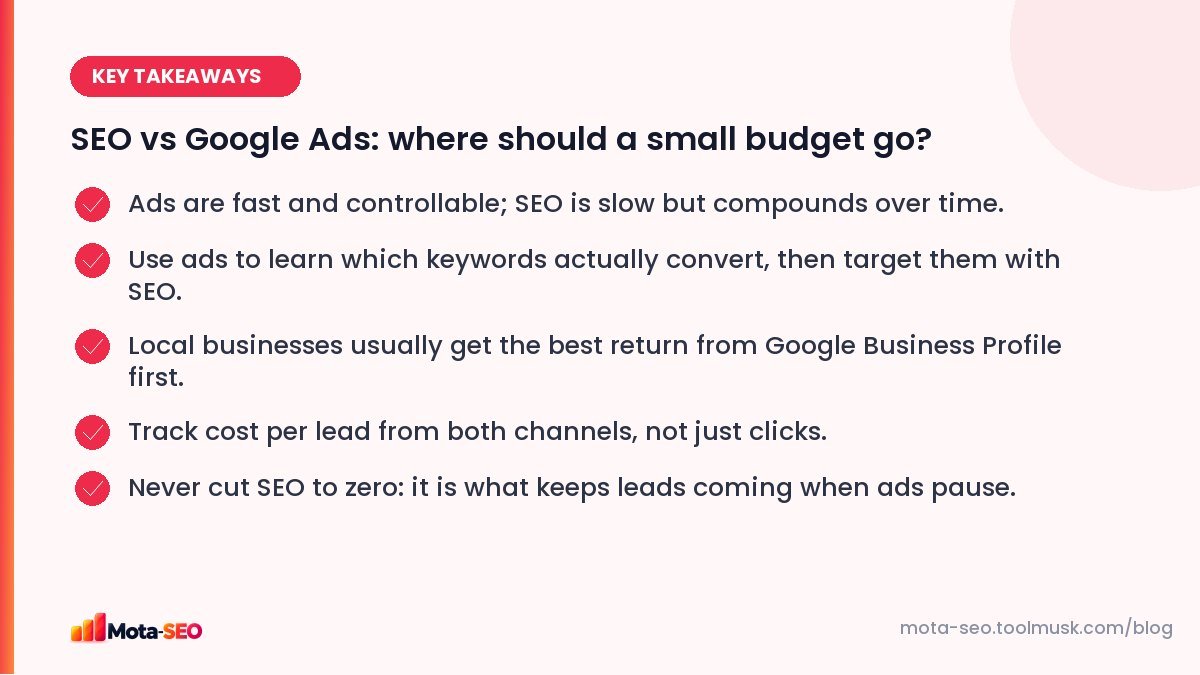
Key takeaways from this guide
How each one works, in one paragraph
Google Ads: you bid on keywords and pay each time someone clicks your ad. Your ad can appear above the organic results today. Stop paying and it disappears today.
SEO: you improve your website and reputation so Google ranks your pages in the free, organic results. You don't pay per click, but it takes time and work (yours or someone else's) and there are no guarantees.
The comparison
| Google Ads | SEO | |
|---|---|---|
| Speed | Same day | Months |
| Cost model | Pay per click, forever | Time or fees up front; clicks are free |
| When you stop | Traffic stops | Traffic slowly declines, often over many months |
| Control | High: choose keywords, budget, timing, location | Low: Google decides rankings |
| Trust from searchers | Many people skip ads | Organic results tend to get more clicks |
| Data | Exact keywords and conversions | Search Console shows queries; less precise |
| Best for | Testing, seasonal offers, launches, urgent leads | Steady leads, informational searches, brand building |
When ads make more sense
- You need leads this month. A new clinic, a seasonal sale, an event.
- Clicks are cheap in your niche and each customer is valuable.
- You're testing an offer and want to know quickly whether anyone searches for it and converts.
- The organic results are dominated by huge sites you can't realistically outrank soon.
When SEO makes more sense
- Clicks are expensive, as in legal, insurance, finance and many B2B services.
- People research before buying, so helpful guides can attract them early.
- You're local and the competition is weak; a solid site and Business Profile can win quickly.
- You're building something long term and want an asset that keeps working.
The trick most small businesses miss: use ads to research SEO
Ads give you something SEO can't: precise data about which searches lead to sales. Run a small campaign for a month on your main services, look at the search terms report, and note which phrases actually produce enquiries. Those are the keywords worth building pages for. It turns a few thousand rupees of ad spend into a keyword strategy you'd otherwise guess at.
Our keyword match type generator helps set up those campaigns, and our match types guide explains which to use so the budget isn't wasted on loosely related searches.
A simple way to split a small budget
There's no universal formula, but this is a reasonable starting point for a small service business:
| Phase | Ads | SEO | Goal |
|---|---|---|---|
| Months 1–3 | 60–70% | 30–40% | Leads now; learn which keywords convert; fix the site's foundations. |
| Months 4–9 | 40–50% | 50–60% | Build pages for converting keywords; improve Business Profile and reviews. |
| Month 10+ | Adjust to results | Adjust to results | Keep ads for what organic doesn't cover yet. |
The SEO share doesn't have to mean paying an agency. For many small businesses it means the owner spending a few hours a week on service pages, photos and reviews, which is often the most effective SEO there is.
Measure both the same way
Compare channels by cost per lead (or per sale), not cost per click. Tag your ad and campaign links properly, using our UTM builder for anything outside Google Ads, and track form submissions and calls from each source. Our UTM guide shows how to keep the data clean.
A common surprise: once SEO starts working, the cost per lead from organic search is often a fraction of the cost from ads, but only after the first several months of investment.
What your ads can teach your organic listings
Ads let you test messages quickly. If an ad headline mentioning "same-day service" gets twice the click-through rate of one saying "experienced technicians", that's a strong hint about what your customers care about. Use the winning angle in your page titles and meta descriptions too.
It works the other way as well: a page title that earns a high CTR in organic search is a good candidate for ad copy. Treat the two channels as one testing ground for your messaging. Our guides to meta titles and meta descriptions show how to write the organic side.
The short answer
If you need customers this month, start with ads, carefully targeted. If you'll still be in business in two years, start SEO now too, because the best time to begin was a year ago. Most small businesses do best with both, shifting the balance toward SEO as it starts to deliver.
Frequently asked questions
Does running Google Ads help SEO rankings?
No. Google keeps paid and organic results separate. Ads can, however, give you useful data on which keywords convert, which helps decide what pages to build for SEO.
How much should a small business spend on Google Ads?
Start with an amount you can afford to test for a month, often a few hundred rupees a day for local services, and judge it by cost per lead. Increase only the campaigns that bring leads at a profitable cost.
Is SEO cheaper than Google Ads?
Over the long run, usually yes, because organic clicks are free once you rank. In the first months SEO costs time or money with little return, while ads return leads immediately.
Can I do SEO and Google Ads at the same time?
Yes, and most businesses should. Ads cover the searches you do not rank for yet, while SEO builds traffic that does not depend on ad spend.

Written by the Mota-SEO team
We build free SEO and website tools. Our guides are practical, written for small teams, and checked against Google's own documentation.
Comments 0