Image alt text: good and bad examples (and why it matters)
Alt text helps blind and low-vision visitors understand your images, and it helps Google understand them too. Most sites either leave it empty or stuff it with keywords. Here is how to write it properly, with examples.
Alt text (the alt attribute on an image) is read aloud by screen readers to people who can't see the image. It also appears if the image fails to load, and it's one of the main ways search engines understand what an image shows.
It's simple in principle, but in audits it's one of the most consistently neglected things on websites. Here's how to get it right without overthinking it.
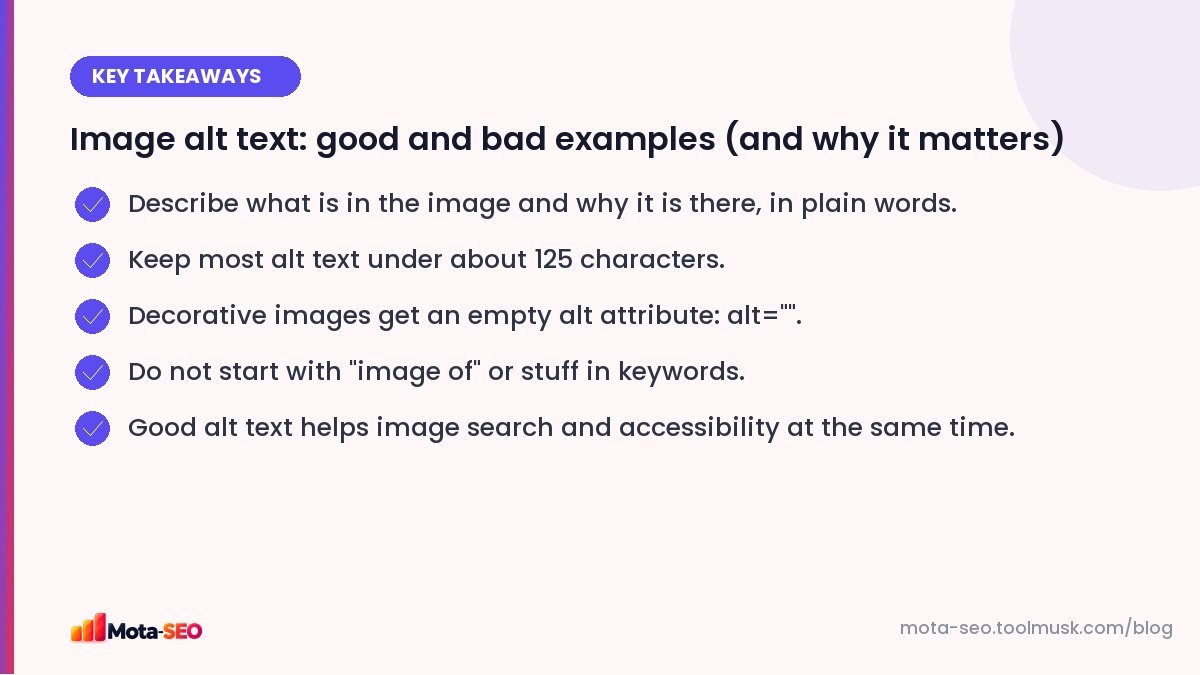
Key takeaways from this guide
What it looks like in HTML
<img src="sunrise-trek-kedarkantha.jpg" alt="Hikers on the snowy Kedarkantha summit ridge at sunrise">In WordPress and most CMSs, there's an "Alt text" or "Alternative text" field when you upload or select an image.
The one-question test
Ask: if I couldn't see this image, what would I need to know about it to understand this page? Write that, briefly. The answer depends on context: the same photo might need different alt text on a product page and on a blog post.
Good and bad examples
| Image | Bad | Good |
|---|---|---|
| Product photo | shoe | Blue suede loafers with tan leather sole, side view |
| Team photo on About page | team | Our six-person design team at the Kochi office |
| Recipe step | image1.jpg | Kneading chapati dough until smooth and slightly sticky |
| Chart | graph | Bar chart: organic traffic grew from 1,200 to 4,800 visits a month between January and June |
| Before/after | before after kitchen renovation best interior designer Mumbai | Kitchen before renovation with old laminate cabinets |
| Logo linking to home | logo | SmileCare Dental home |
| Decorative divider | decorative wave line graphic | (empty: alt="") |
Rules of thumb
- Be specific and concise. Most alt text fits in about 125 characters. If an image needs a long explanation (a complex chart), summarise in the alt text and describe it fully in the surrounding text.
- Skip "image of" or "picture of". Screen readers already announce it's an image.
- Use keywords only where they're true. If the photo is a dental clinic in Pune, saying so is accurate. Listing every service you offer is not.
- Linked images describe the destination. A logo that links home should say "Brand name home", not describe the logo's colours.
- Text in images: if the image contains important words, include them in the alt text, or better, put them in real HTML text.
Decorative images: empty alt, not missing alt
Backgrounds, dividers, and icons next to text that already says the same thing are decorative. Give them alt="" (an empty value) so screen readers skip them. Leaving the attribute out entirely is worse: some screen readers then read the file name, such as "wave-divider-final-v2 dot png".
Does alt text help SEO?
Yes, in two ways. It helps your images appear in Google Images and in image results within regular search, which can be a real traffic source for products, recipes, travel and design. And it adds context about the page's topic. It's not a way to rank for unrelated keywords, and stuffing it can be treated as spam.
Image SEO also depends on the file name (blue-suede-loafers.jpg beats IMG_4021.jpg), the text around the image, and the image being fast to load; see our image optimisation guide.
Fixing alt text on an existing site
- Run your key pages through the image alt text checker to list images with missing or empty alt attributes.
- Start with product images, images in your top blog posts, and any image that's also a link.
- Mark purely decorative images with
alt=""in the theme or template. - Add "write alt text" to your publishing checklist so new content doesn't repeat the problem.
A note on AI-generated alt text
Some tools can now describe images automatically. They're a reasonable starting point for large back catalogues, but review the output: automated descriptions often miss what matters in context ("a woman smiling" rather than "Dr. Mehta explaining an X-ray to a patient"). Context is exactly what a human editor adds.
Frequently asked questions
How long should alt text be?
Usually one short sentence, under about 125 characters. Complex images such as charts can have a short summary in the alt text and a longer description in the page text.
Do decorative images need alt text?
They need an empty alt attribute, alt="", so screen readers skip them. Do not leave the attribute out, and do not describe purely decorative graphics.
Does alt text help with Google rankings?
It helps images rank in Google Images and gives context about the page. It will not make a page rank for unrelated keywords, and keyword stuffing in alt text can hurt.
What is the difference between alt text and an image title?
Alt text describes the image for screen readers and search engines. The title attribute shows as a tooltip on hover in some browsers and is not a substitute for alt text.

Written by the Mota-SEO team
We build free SEO and website tools. Our guides are practical, written for small teams, and checked against Google's own documentation.
Comments 0