UTM parameters: track every campaign link properly
Without UTM tags, traffic from your WhatsApp broadcast, newsletter and Instagram bio all blurs together in analytics. Here is how to tag links so you can see exactly which campaign brought each visitor.
UTM parameters are short tags added to the end of a URL that tell your analytics tool where a visitor came from. Without them, a click from your WhatsApp broadcast might show up as "direct" traffic, and a click from your email newsletter might be lumped in with a dozen other sources.
With them, you can answer the questions that matter: which channel brings customers, which campaign worked, which post was worth the effort.
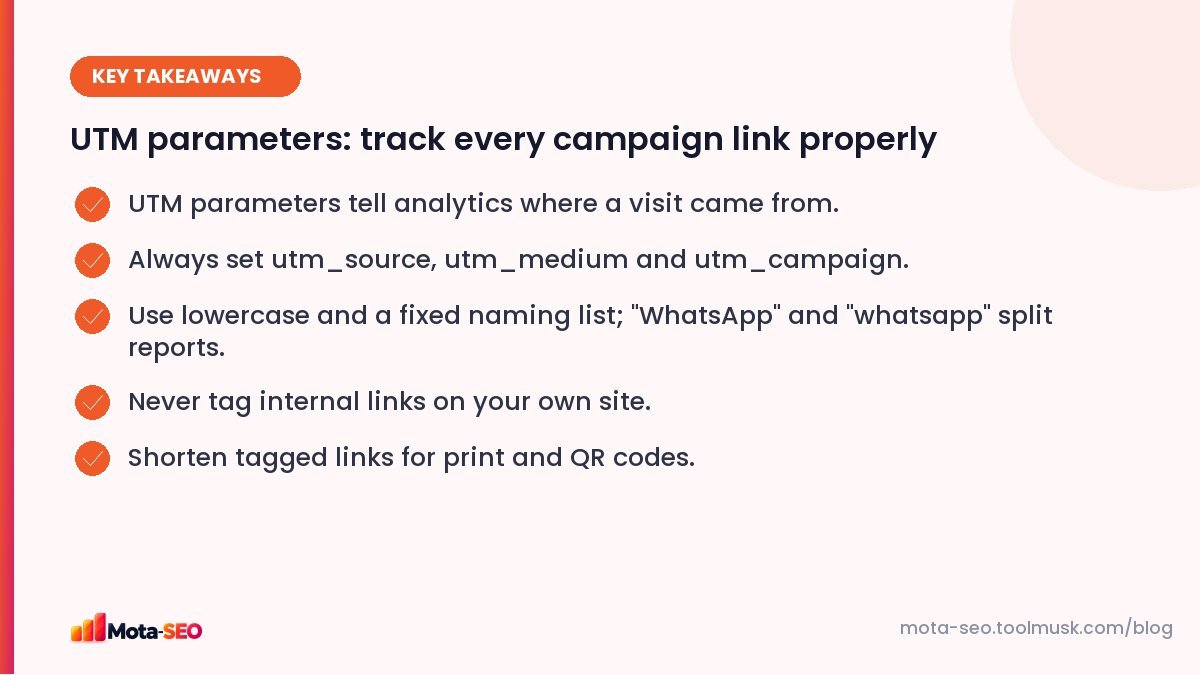
Key takeaways from this guide
What a tagged link looks like
https://example.com/diwali-sale?utm_source=whatsapp&utm_medium=broadcast&utm_campaign=diwali_2026Everything after the ? is for analytics. The page itself loads exactly the same.
The five parameters
| Parameter | Answers | Examples |
|---|---|---|
| utm_source (required) | Where exactly? | whatsapp, newsletter, instagram, facebook, partner_site |
| utm_medium (required) | What type of channel? | broadcast, email, social, cpc, referral, qr, print |
| utm_campaign (required) | Which campaign? | diwali_2026, new_menu_launch, webinar_oct |
| utm_content (optional) | Which version or placement? | header_button, story_link, video_a |
| utm_term (optional) | Which keyword? (mainly paid search) | ac_repair_pune |
Analytics tools group traffic into channels partly by the medium value, so use standard mediums like email, social, cpc and referral where they fit, so your channel reports stay accurate.
Naming conventions: the part everyone gets wrong
UTM values are case-sensitive. WhatsApp, whatsapp and whats_app appear as three different sources. After a few months of different people tagging links, reports become useless.
Fix it with simple rules:
- lowercase only,
- underscores instead of spaces,
- a shared list of allowed sources and mediums (a one-page document is enough),
- campaign names with a date or year:
diwali_2026, notsale.
Examples for common channels
| Channel | source | medium | campaign |
|---|---|---|---|
| WhatsApp broadcast | broadcast | diwali_2026 | |
| Email newsletter | newsletter | oct_2026_issue | |
| Instagram bio link | social | bio_link | |
| Facebook post (organic) | social | new_menu_launch | |
| Flyer QR code | flyer | qr | store_opening_pune |
| Partner website | partner_name | referral | co_marketing_q4 |
Google Ads can tag links automatically (auto-tagging), so you usually don't need UTMs there if it's linked to your analytics.
Building links quickly
Our UTM builder creates tagged links from a form, so nobody has to type parameters by hand. To check an existing link's parameters, paste it into the URL parser.
Mistakes to avoid
- Tagging internal links. A UTM on a link from your homepage to your pricing page starts a new session in some analytics setups and overwrites the real source. Use UTMs only on links from outside your site.
- Personal data in UTMs. Never put emails or phone numbers in parameters; they end up in analytics and logs.
- Inconsistent spelling, covered above.
- Very long links in print: use a short link or a QR code. Our QR generator makes codes from tagged URLs; see our QR and WhatsApp marketing guide.
A worked example: one festival offer, five channels
Say a sweet shop in Indore runs a Diwali pre-order offer and promotes the same landing page everywhere. Without tags, analytics would show a vague rise in "direct" and "social" traffic. With tags, each link is distinct:
| Where the link goes out | Tagged link (parameters only) |
|---|---|
| WhatsApp broadcast to past customers | ?utm_source=whatsapp&utm_medium=broadcast&utm_campaign=diwali_2026 |
| Instagram story | ?utm_source=instagram&utm_medium=social&utm_campaign=diwali_2026&utm_content=story |
| Instagram bio | ?utm_source=instagram&utm_medium=social&utm_campaign=diwali_2026&utm_content=bio |
| Email to corporate clients | ?utm_source=newsletter&utm_medium=email&utm_campaign=diwali_2026&utm_content=corporate |
| QR code on the counter standee | ?utm_source=standee&utm_medium=qr&utm_campaign=diwali_2026 |
After the festival, filtering by diwali_2026 shows how many visits and pre-orders each channel produced. If the WhatsApp broadcast brought most orders and the Instagram bio almost none, next year's effort goes where it works.
One more tip for links shared on WhatsApp: the preview card that appears with the link decides whether people tap it at all. Make sure the landing page has proper Open Graph tags; see how to control link previews.
Do UTMs affect SEO?
Not if handled correctly. Tagged URLs are the same page with extra parameters. Make sure your pages have a self-referencing canonical tag (see canonical tags), so if a tagged URL ever gets crawled, Google consolidates it with the clean version.
Reading the results
In your analytics tool, look at traffic acquisition by source/medium and by campaign. The useful question isn't "which link got the most clicks" but "which campaign brought enquiries or sales". Set up conversions (form submissions, calls, purchases) so you can compare campaigns on outcomes.
Frequently asked questions
What are UTM parameters?
Tags added to a URL, such as utm_source and utm_campaign, that tell analytics tools where a visitor came from.
Which UTM parameters are required?
Use utm_source, utm_medium and utm_campaign on every tagged link. utm_content and utm_term are optional.
Do UTM parameters hurt SEO?
No, as long as your pages have self-referencing canonical tags so search engines treat tagged URLs as the same page.
Should I use UTM tags on internal links?
No. Tagging links between your own pages can overwrite the original traffic source in analytics.

Written by the Mota-SEO team
We build free SEO and website tools. Our guides are practical, written for small teams, and checked against Google's own documentation.
Comments 0