Search intent explained: match your page to what people want
You can write the best product page on the internet and still never rank for a keyword where Google shows guides. Search intent is the reason. Here is how to read it and build the right kind of page.
Search intent is the reason behind a search: what the person actually wants to get done. Two searches about the same subject can have completely different intents, and Google has become very good at telling them apart.
That's why intent is the first thing to get right. A page that doesn't match it won't rank well, however well written or optimised.
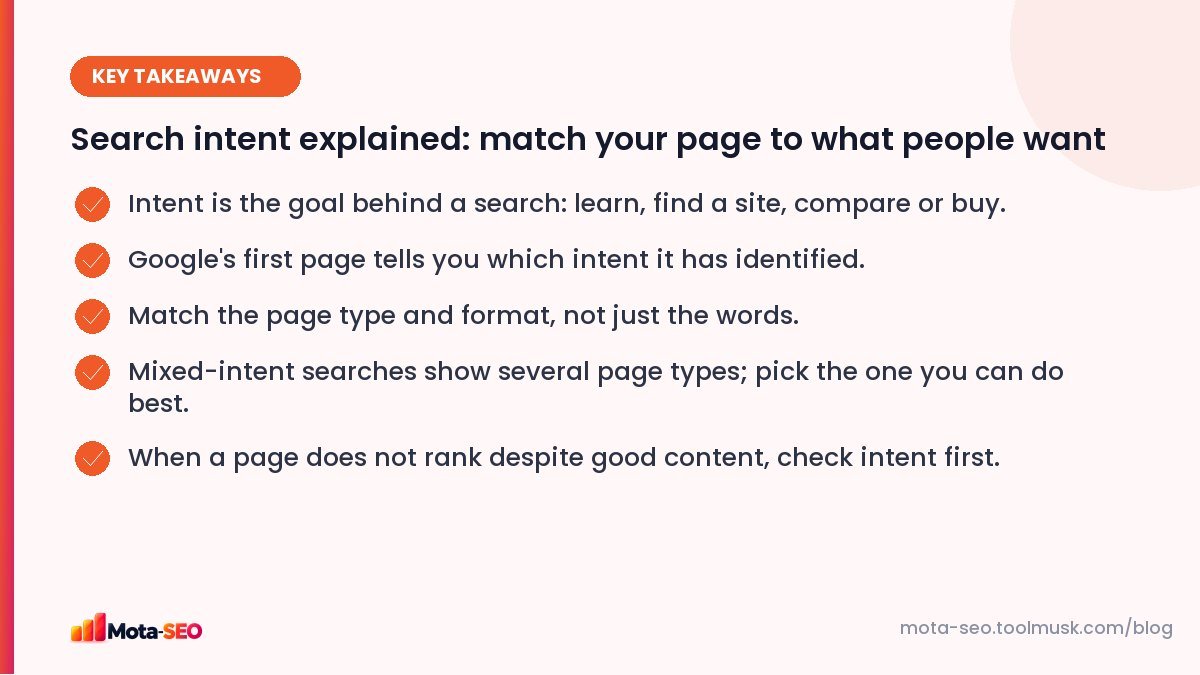
Key takeaways from this guide
The four types of intent
| Intent | The person wants to… | Example search | Page that ranks |
|---|---|---|---|
| Informational | learn or understand something | how does a water purifier work | Guides, explainers |
| Navigational | reach a specific site or page | irctc login | That site's page |
| Commercial investigation | compare options before buying | best water purifier for home under 15000 | Comparisons, reviews, lists |
| Transactional | buy, book or sign up now | buy kent ro purifier online | Product and category pages |
Local searches ("water purifier service near me") are often their own blend: transactional with a location, answered by the map pack and local business pages.
How to read intent: look at the results
You don't need to guess. Google has already analysed what people click and stay on for each search. Search your keyword and note:
- Page type: are the top results product pages, category pages, blog guides, videos, tools, local listings?
- Format: step-by-step guides, lists, comparisons, calculators?
- Angle: "for beginners", "in 2026", "cheap", "for small business"?
- Search features: a map pack (local), shopping results (transactional), "People also ask" (informational), video carousels.
If eight of the top ten results are buying guides, a product page won't break in. Build a buying guide, then link it to your products.
Same topic, different pages
Consider a home interior business in Hyderabad:
- "modular kitchen design ideas" → informational. Needs a gallery or ideas article.
- "modular kitchen cost for 2bhk" → commercial. Needs a pricing guide with real numbers.
- "modular kitchen designers in Hyderabad" → local, transactional. Needs a service page and a strong Business Profile.
- "[brand name] modular kitchen reviews" → navigational/commercial. Needs your reviews and case studies to be findable.
Four searches, four different pages. Trying to rank one page for all of them usually means ranking for none.
Mixed intent
Some searches show a mix: a couple of product pages, a couple of guides, a video. That means Google isn't sure which intent dominates, or that people want different things. Pick the format you can do best, and make it unusually good. Mixed-intent searches are often where smaller sites can find a gap.
"Near me" and local intent
Searches like "chartered accountant near me" or "best momos in Lajpat Nagar" have local intent: Google shows a map with businesses first, then local pages. For these, a blog post rarely ranks. What ranks is a complete Google Business Profile and a service page that clearly states the location.
Interestingly, many local-intent searches don't include a place at all. "Dentist" or "AC repair" typed on a phone is treated as local because Google knows that's what most people want. If your business depends on local customers, check the results for your main service without a city name too; you may find the map pack is the main battleground.
If you're new to how Google decides what to show for each search, start with how Google ranks pages.
Intent changes over time
Around festivals, "diwali gifts" leans transactional; earlier in the year it's more about ideas. A news event can turn a product search informational overnight. Re-check the results for your important keywords a couple of times a year.
Fixing a page that misses intent
Signs of an intent mismatch:
- the page gets impressions but almost no clicks (Google tests it, searchers ignore it),
- it ranks on page two or three for months despite good content and links,
- visitors leave quickly without scrolling.
Fixes, from small to large:
- Change the angle: add the missing element the top results all have (prices, a comparison table, steps).
- Change the format: turn a wall of text into a step-by-step guide or a comparison.
- Change the page type: build a separate guide for the informational search and keep the product page for the buying search, linking them together.
Intent and your titles
Your title should signal the intent you serve. "Modular Kitchen Cost for 2BHK in Hyderabad (2026 Price Guide)" promises numbers to a cost searcher. "Modular Kitchen Designers in Hyderabad | Free Site Visit" promises a service. See how to write a meta title.
Intent is the bridge between keyword research and content. Once you know what people want, writing the right page becomes much more straightforward.
Frequently asked questions
What are the four types of search intent?
Informational (learn), navigational (find a specific site), commercial investigation (compare before buying) and transactional (buy or act now).
How do I find the search intent of a keyword?
Search it on Google and look at the types of pages ranking, their format and angle, and any special features like maps or shopping results.
Why does my page not rank even though the content is good?
A common reason is intent mismatch: your page type or format does not match what Google shows for that search, such as a product page for a search where guides rank.
Can one page target several intents?
Rarely well. It is usually better to create separate pages for different intents and link them to each other.

Written by the Mota-SEO team
We build free SEO and website tools. Our guides are practical, written for small teams, and checked against Google's own documentation.
Comments 0