How long does SEO take? Realistic timelines by type of website
Anyone who promises page one in 30 days is guessing or cheating. Here are realistic timelines for different kinds of sites, the factors that change them, and what progress should look like month by month.
"How long until we're on page one?" is the first question every client asks, and the honest answer, "it depends", sounds like a dodge. So let's make it concrete. Below are the timelines we'd actually expect for different situations, why they differ, and what you should see along the way so you know it's working.
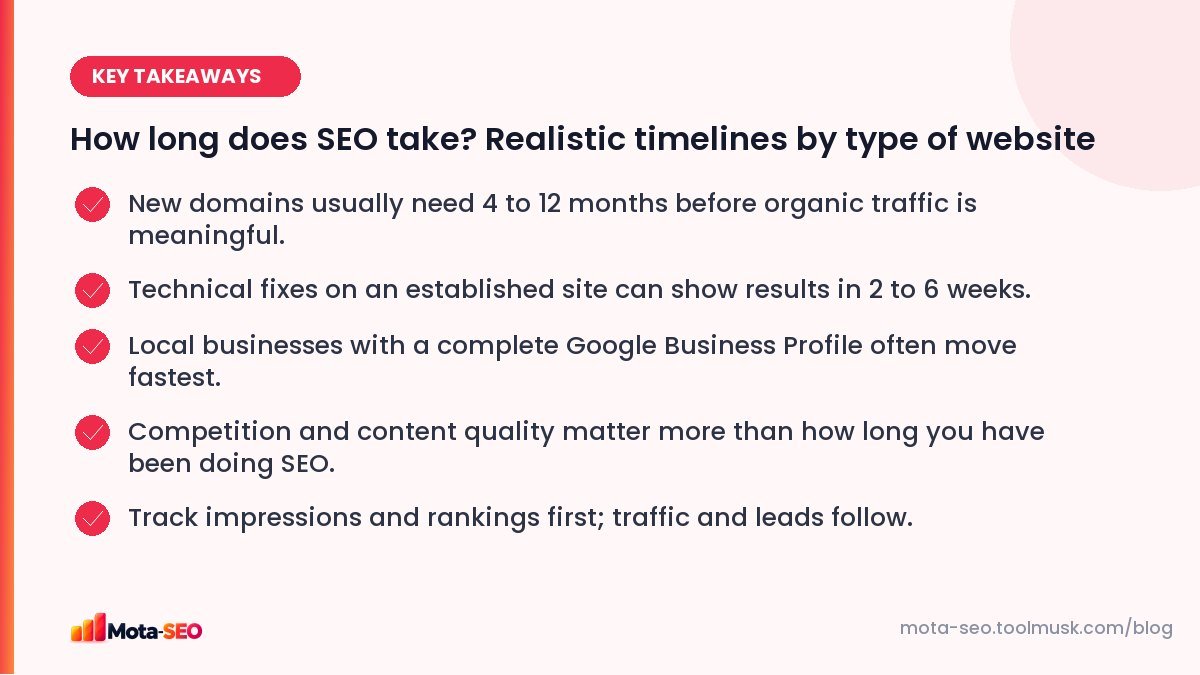
Key takeaways from this guide
Why SEO is slow at all
Three things put a floor under the timeline.
Google has to recrawl. A change you make today isn't seen until Googlebot visits the page again. Important pages on an active site get recrawled within days; deep pages on a small site can wait weeks.
Google has to trust you. A brand-new domain has no history: no links, no brand searches, no record of satisfying visitors. Google is cautious about ranking such sites for anything competitive. Trust builds as other sites mention you and as people search for you by name.
The competition isn't standing still. The pages ranking today have years of links and content behind them, and they keep improving too. You aren't racing a clock; you're overtaking someone.
Realistic timelines by situation
| Situation | First signs | Meaningful traffic |
|---|---|---|
| Brand-new domain, competitive niche | 2–4 months | 9–18 months |
| Brand-new domain, low competition | 1–2 months | 4–8 months |
| Local business (city searches) | 3–8 weeks | 2–6 months |
| Established site, technical problems fixed | 2–6 weeks | 1–3 months |
| Established site, new content section | 1–3 months | 4–9 months |
| Online shop, new category pages | 1–2 months | 3–6 months |
"First signs" means new impressions in Search Console and some long, specific searches ranking. "Meaningful traffic" means enough visits that the business notices.
Local businesses move faster
A plumber in Nagpur isn't competing with every plumbing website in the world, just with the handful in that city. A complete Google Business Profile, a page per service and some genuine reviews can show results in the map pack within weeks. That's why we usually tell local businesses to start there before blogging.
Fixing technical problems can be almost instant
It happens more often than you'd think: a whole blog accidentally set to noindex. Removing the tag brought traffic back within two or three weeks, the time it took Google to recrawl. The same goes for fixing broken redirects after a migration or unblocking resources in robots.txt. If your site used to rank and dropped, look for a technical cause before anything else; our one-afternoon SEO audit covers the usual suspects.
What speeds things up
- Targeting specific, long searches first. "Chartered accountant for startups in Pune" is winnable in weeks. "Chartered accountant" is not. See why long-tail keywords suit small sites.
- Genuinely better content. Original photos, real prices, worked examples, opinions backed by experience.
- Links from relevant sites. A mention from your industry association or a local news site is worth more than fifty directory listings.
- A clean technical base. Fast pages, no crawl errors, a clear internal link structure.
- Publishing consistently. Two solid articles a month for a year beats twenty in one week and then nothing.
What slows it down
- Thin pages that say what every competitor says.
- Changing URLs repeatedly without redirects.
- A site that is slow or broken on mobile.
- Bought links that Google discounts, or worse, penalises.
- Expecting the homepage to rank for everything instead of building pages for each topic.
What progress looks like month by month
Traffic is a lagging indicator. If you only watch traffic you'll think nothing is happening for months, then wonder what changed. Watch these instead, roughly in this order:
- Indexing (weeks 1–4): are your pages in Google? Search Console → Pages.
- Impressions (months 1–3): is Google showing your pages for more searches, even on page three or four? Search Console → Performance.
- Average position for target phrases (months 2–6): moving from 40 to 15 is real progress even though nobody clicks on page two.
- Clicks and traffic (months 3+): follow once positions reach the first page.
- Leads and sales: the number the business actually cares about.
If you're reporting to a client or a manager, show impressions and positions from month one. It saves a lot of nervous conversations in month three.
A note on "guaranteed rankings"
Nobody controls Google's results. Agencies that guarantee positions either target phrases nobody searches for, or use tactics (bought links, private blog networks) that work until they don't, and then take the site down with them. Google's own guidance on hiring an SEO says the same thing: be wary of guarantees.
So, how long?
For most small businesses doing things properly, you should see clear signs within three months and real results within six to nine. If after six months impressions are flat, something is wrong with the strategy, the content or the site, and it's worth stopping to find out what rather than doing more of the same.
Frequently asked questions
Can SEO work in one month?
Sometimes, for very specific local or long-tail searches, or when you fix a technical problem that was blocking an established site. For competitive keywords on a new site, one month is far too short.
Why did my rankings drop after I started SEO?
Small drops are common for a few weeks after big changes while Google reprocesses the site. A sharp, lasting drop usually points to a technical issue such as missing redirects, noindex tags or removed content.
Is it worth doing SEO if it takes so long?
For most businesses, yes. Unlike ads, the traffic does not stop when you stop paying, and good pages keep bringing visitors for years. Many businesses run ads for quick results while SEO builds up.
How do I know if my SEO agency is doing a good job?
Ask for monthly numbers on indexed pages, impressions, average positions for agreed keywords, and organic leads, plus a list of the work done. Rising impressions within three months is a good early sign.

Written by the Mota-SEO team
We build free SEO and website tools. Our guides are practical, written for small teams, and checked against Google's own documentation.
Comments 0