Long-tail keywords: how small sites win searches big sites ignore
You will not outrank Amazon for "shoes". You might easily rank for "wide fit school shoes for flat feet in Bangalore". Long-tail searches are specific, less competitive and often closer to a purchase. Here is how to use them.

"Long-tail" describes the huge number of specific, lower-volume searches, as opposed to the small number of short, popular "head" terms. "Running shoes" is a head term. "Lightweight running shoes for flat feet under 3000" is long-tail.
Each long-tail search is small on its own. Together, they're a big share of what people type into Google, and for a small site they're where most of the realistic opportunity is.
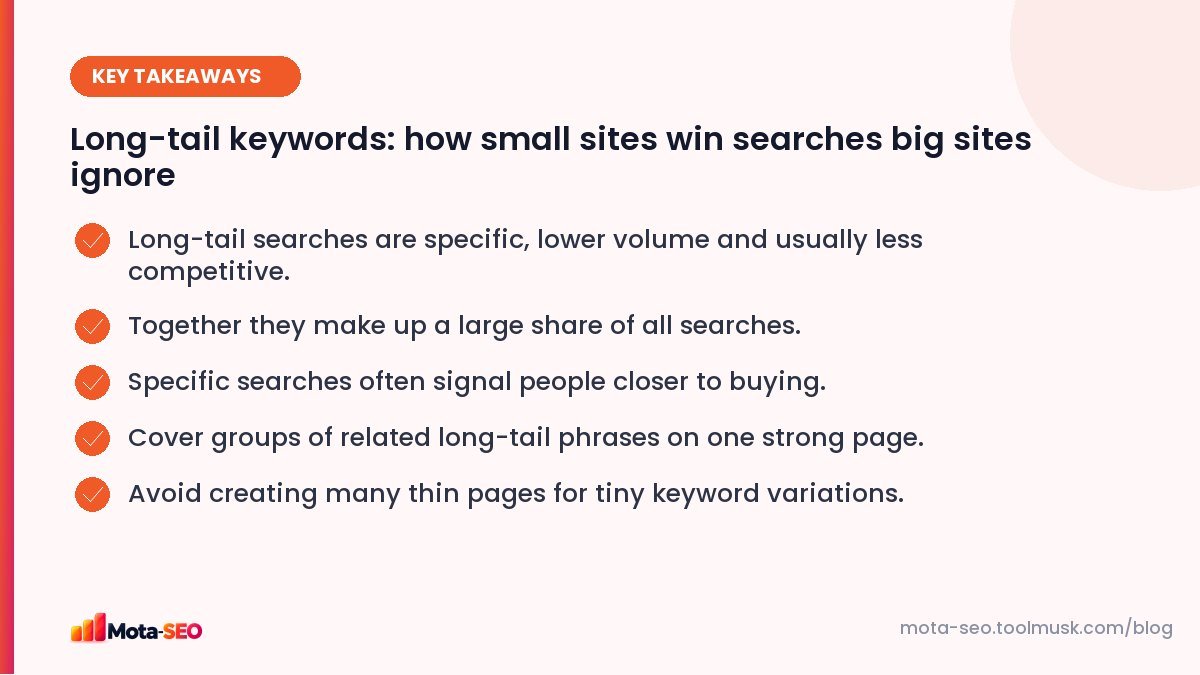
Key takeaways from this guide
Why long-tail suits small sites
Less competition
Big brands and marketplaces dominate head terms with enormous authority. Very specific searches are often answered poorly, by a forum thread, an old blog post, or a generic category page. A focused, genuinely useful page can rank there within weeks.
Clearer intent
"Accounting software" could mean anything. "GST billing software for a small medical shop" tells you exactly who's searching and what they need. Specific searches are easier to answer well.
Better conversion
Specific searches tend to come later in the buying journey. Someone typing a model number, a city name or a precise problem usually knows what they want. Fewer visitors, but more of them become customers.
Types of long-tail searches
| Type | Example |
|---|---|
| Location | pet groomer that comes home in Gurgaon sector 56 |
| Problem | washing machine not draining water LG front load |
| Comparison | tata nexon ev vs mg zs ev running cost |
| Specification | 4 burner glass gas stove with auto ignition under 5000 |
| Audience | yoga classes for seniors with knee pain |
| Question | can I file ITR after due date with late fee |
Finding long-tail keywords for free
- Google autocomplete: type your topic plus a modifier ("for", "with", "without", "near", "vs", "under") and note the suggestions.
- People also ask: each question is a long-tail search.
- Search Console: filter queries containing four or more words; you're probably already appearing for some.
- Customer conversations: the exact phrasing people use on WhatsApp is often the exact phrasing they search.
- Forums and Q&A sites: Reddit, Quora and niche communities show how people describe problems.
Our keyword combiner helps generate combinations of a product with modifiers and places, and our full free keyword research method explains how to organise the results.
How to build pages around them
One page per intent, not per phrase
"Washing machine not draining", "washing machine water not going out" and "front load washer drain problem" are the same need. One thorough troubleshooting page answers all of them. Making three nearly identical pages creates duplicate content and splits your signals.
Use them as sections in bigger pages
Many long-tail questions don't need their own page. A comprehensive guide to "choosing a gas stove" can have sections answering "auto ignition vs manual", "glass vs steel top" and "best size for a family of four". That one page can rank for dozens of specific searches.
Give them their own page when the intent is distinct
"Gas stove repair in Lucknow" is a different need from "how to choose a gas stove". Different intent, different page.
A worked example
A small physiotherapy clinic in Pune can't compete for "physiotherapy". But it can build:
- a service page for "frozen shoulder physiotherapy in Kothrud, Pune",
- a guide answering "how many physio sessions for frozen shoulder",
- a page on "home visit physiotherapy for elderly in Pune",
- an FAQ section covering "is physiotherapy covered by health insurance".
Each targets searches with modest volume, weak competition and patients who are ready to book.
Finding long-tail wins in pages you already have
Before writing anything new, open Search Console and look at the queries for your existing pages. You'll often find long, specific searches where a page sits at position 8–15 without ever mentioning the exact question. Adding a short section that answers it directly is one of the quickest wins in SEO, and it's exactly the kind of improvement our content refresh process is built around.
What to avoid
- Doorway pages: hundreds of near-identical pages swapping a city or a keyword. Google's spam policies specifically target these.
- Writing for the phrase, not the person. "Best cheap good quality shoes for men price" is a real search, but don't put it in a heading verbatim.
- Ignoring head terms entirely. Long-tail pages, well linked together, build the authority that eventually helps you compete for broader terms too.
The long tail is where a small site's specific knowledge becomes an advantage. Big sites write for everyone; you can write for exactly the person searching.
Frequently asked questions
What is a long-tail keyword?
A specific search phrase, usually three words or more, with lower search volume than broad terms, like "home visit physiotherapy for elderly in Pune".
Are long-tail keywords easier to rank for?
Usually, yes. Fewer and less authoritative sites compete for them, and a focused, helpful page can rank relatively quickly.
Should I make a page for every long-tail keyword?
No. Group phrases with the same intent onto one page, and answer smaller questions as sections within broader guides.
Do long-tail keywords convert better?
Often. Specific searches tend to come from people who know what they need, so a smaller number of visitors can bring more enquiries or sales.

Written by the Mota-SEO team
We build free SEO and website tools. Our guides are practical, written for small teams, and checked against Google's own documentation.



Comments 0