FAQ schema: how to add it, and what to realistically expect
FAQ schema used to give almost any page extra space in Google results. Since 2023, those rich results are shown only for a small group of authoritative sites. Here is what that means and why a good FAQ section is still worth having.

For a few years, FAQ schema was a favourite SEO trick. Add a few questions to the bottom of a page, mark them up with FAQPage structured data, and Google would often show them as expandable questions under your result, pushing competitors further down.
That changed in August 2023, when Google announced it would show FAQ rich results only for well-known, authoritative government and health websites. If you've added FAQ schema recently and wondered why nothing appears, that's why.
So is it still worth doing? Partly. Here's the honest picture.
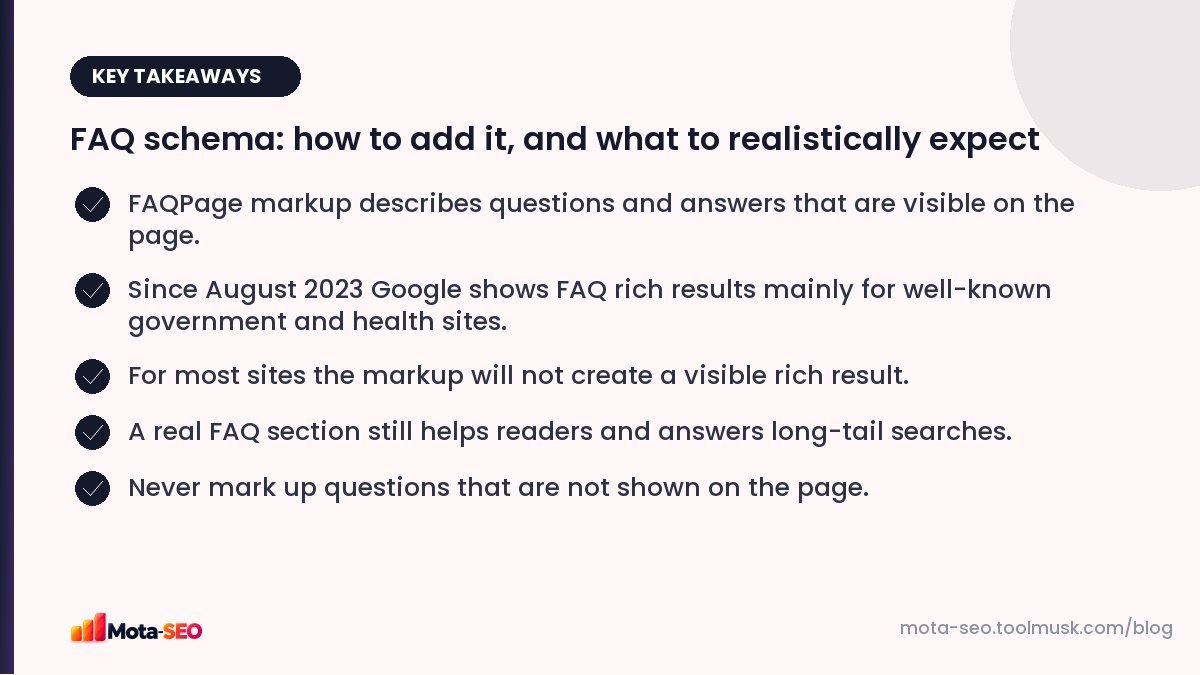
Key takeaways from this guide
What FAQ schema is
FAQPage is a schema.org type that lists questions and their answers. In JSON-LD:
<script type="application/ld+json">
{
  "@context": "https://schema.org",
  "@type": "FAQPage",
  "mainEntity": [
    {
      "@type": "Question",
      "name": "How long does a root canal take?",
      "acceptedAnswer": {
        "@type": "Answer",
        "text": "Most root canals take one or two visits of 60 to 90 minutes each."
      }
    },
    {
      "@type": "Question",
      "name": "Is a root canal painful?",
      "acceptedAnswer": {
        "@type": "Answer",
        "text": "With local anaesthesia it usually feels similar to getting a filling."
      }
    }
  ]
}
</script>
Our FAQ schema generator turns a list of questions and answers into this code.
What to expect after the 2023 change
- Most business and blog sites won't get FAQ rich results, even with perfect markup.
- The markup isn't harmful. Google said sites can keep it; it just won't produce the visual feature for most.
- Search Console's FAQ enhancement report was retired along with the change.
Related: HowTo rich results were removed from Google Search around the same time, so HowTo markup no longer produces a visible feature either.
Why an FAQ section is still worth having
Forget the markup for a moment. A well-written FAQ section on the page itself still pays off:
- It answers objections that stop people buying or enquiring: price, timing, guarantees, process.
- It targets long-tail questions people actually search ("can I get a root canal on a Sunday in Pune?").
- It's easy to quote. Clear question-and-answer pairs are the kind of content search features and AI summaries can pick up accurately.
- It reduces support load when the same questions come in every week.
Writing FAQs that help
Use real questions
Take them from customer emails, WhatsApp chats, sales calls, Google's "People also ask" box and the queries report in Search Console. Invented questions ("Why is our company the best?") help nobody.
Answer in the first sentence
"Most root canals take one or two visits of 60–90 minutes." Then add detail. Don't start with "That's a great question".
Keep each answer focused
Two to four sentences. If an answer needs 500 words, it deserves its own section or page, linked from the FAQ.
Don't repeat the same FAQ on every page
Each page's FAQs should be about that page's topic. Site-wide boilerplate FAQs add duplicate text everywhere.
Rules if you do add the markup
- The questions and answers must be visible on the page, word for word or very close.
- Use FAQPage only where the site provides the answers. User-submitted questions with several answers belong under QAPage.
- No advertising in answers, and nothing offensive or misleading.
- One FAQPage block per page; don't duplicate it across templates.
Validate the JSON with the JSON validator and the result with Google's Rich Results Test. For other types that still produce rich results, read our schema markup guide.
Where to put the FAQ on the page
Usually near the end, after the main content, so it catches the questions people still have when they've read the rest. On service pages, an FAQ just above the final call to action works well: it removes the last doubts before someone calls or books.
Keep the number reasonable. Five to eight good questions are more useful than twenty padded ones, and long FAQ sections push your contact details further down on mobile.
One more use for your FAQ: the questions people ask are often the best material for your meta description. If everyone asks about price, mention the starting price in the description. See how to write meta descriptions.
Our recommendation
Add FAQ sections where readers genuinely have questions. Add the markup if it's easy (most CMS plugins do it automatically), because it's harmless and describes your content accurately. But don't expect it to change how your result looks, and don't spend days on it. That time is better spent improving the answers themselves.
Frequently asked questions
Does FAQ schema still work in 2026?
The markup is still valid, but since August 2023 Google shows FAQ rich results only for a limited set of well-known authoritative government and health sites. Most other sites will not see the expandable questions.
Will FAQ schema hurt my site?
No. Google said sites can keep FAQPage markup. It simply will not produce a visible rich result for most sites.
Is an FAQ section good for SEO without schema?
Yes. Clear answers to real questions help readers, can rank for long-tail searches, and are easy for search features to understand.
What is the difference between FAQPage and QAPage?
FAQPage is for questions answered by the site itself. QAPage is for pages where users ask a question and others submit answers, like a forum thread.

Written by the Mota-SEO team
We build free SEO and website tools. Our guides are practical, written for small teams, and checked against Google's own documentation.



Comments 0