NAP consistency and local citations: why your address matters online
Your business name, address and phone number appear in dozens of places online. When they disagree, customers call dead numbers and Google trusts the details less. Here is how to audit and fix them.

NAP stands for Name, Address and Phone number. A citation is any online mention of those details: a directory listing, a map app, a social profile, a supplier's dealer list. For local businesses, consistent citations help customers reach you and help search engines feel confident about where and what you are.
The problem is that citations multiply on their own. Data aggregators copy listings, old employees create profiles, and after a move or a new phone number, the old details live on for years.
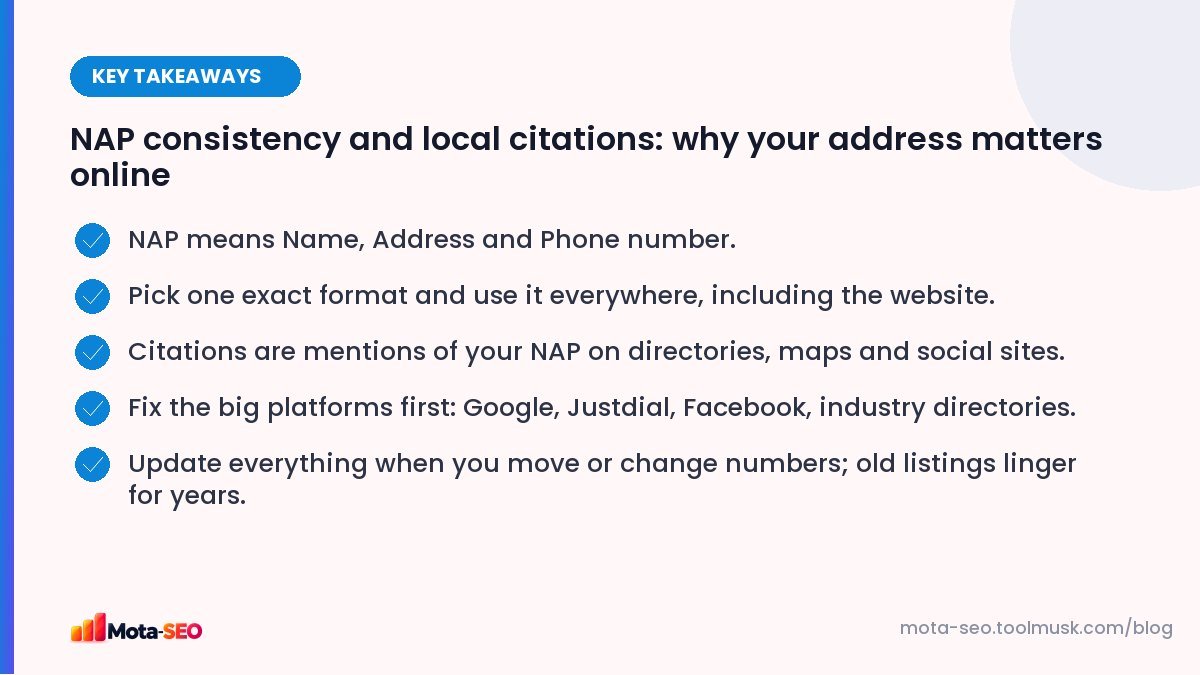
Key takeaways from this guide
Why consistency matters
For customers, it's obvious: an old number on Justdial means a lost call, an old address on a map means an annoyed visitor.
For search engines, consistent details across many independent sources confirm that your business is real and located where you say. Inconsistent details create doubt. Citations are a smaller local ranking factor than they used to be, compared with reviews and the Business Profile, but inconsistency still causes real problems.
Step 1: Choose your canonical NAP
Decide the exact format and write it down:
Name:    SmileCare Dental Clinic
Address: Shop 4, Sai Plaza, 12 FC Road, Shivajinagar, Pune, Maharashtra 411004
Phone: +91 20 5555 0123- Use your real, registered trading name, without keywords.
- Pick one style for abbreviations ("Road" vs "Rd") and stick with it.
- Prefer a landline or a stable business mobile over a personal number.
- Include the PIN code; it removes ambiguity between similarly named areas.
Step 2: Fix your own website
Your website should show the canonical NAP as text (not an image), usually in the footer and on the contact page. Add LocalBusiness structured data with the same details; see our schema guide.
Step 3: Audit existing citations
Search Google for:
- your business name,
- your phone number in quotes (with and without spaces and +91),
- your old address and old phone number,
- your name plus your city.
List every listing you find in a spreadsheet: platform, URL, name, address, phone, correct or not, login available or not.
Step 4: Fix the important ones first
| Priority | Platforms |
|---|---|
| 1 | Google Business Profile (see our guide), your website |
| 2 | Justdial, Facebook page, Instagram bio, Apple Maps, Bing Places |
| 3 | Industry directories: Practo, Zomato, IndiaMART, Sulekha, 99acres and similar |
| 4 | Local chambers of commerce, associations, supplier dealer lists |
| 5 | Smaller general directories |
Claim listings where you can and edit them. Where you can't claim a listing, most platforms have a "suggest an edit" or support form.
Step 5: Remove duplicates
Duplicate listings for the same business on the same platform split reviews and confuse customers. On Google, report duplicates or merge them through support. On directories, ask support to remove or merge the extra listing.
Moving or changing your number
When you move:
- Update Google Business Profile first (with proof if asked).
- Update your website and structured data.
- Work through your citation spreadsheet in priority order.
- Keep the old phone number forwarding for as long as you can; old listings will keep sending calls.
- Check again after three months; some platforms revert edits from data aggregators.
Building new citations
For a new business, a handful of high-quality, relevant listings beats hundreds of junk directories. Focus on the platforms your customers actually use, plus the major maps and your industry's main directory. Paid "submit to 500 directories" packages mostly produce low-value listings that are a pain to update later.
How long a clean-up really takes
For a typical single-location business that has been around for a few years, expect something like this:
| Task | Time |
|---|---|
| Searching and listing existing citations | 1–2 hours |
| Fixing Google, website, Facebook, Instagram | 1 hour |
| Claiming and editing major directories | 2–4 hours spread over a week (verification calls and emails take time) |
| Requesting removals of duplicates | 30 minutes, then waiting |
| Re-checking after a month | 30 minutes |
The slow part is waiting for platforms to verify ownership or process edits. Keep the spreadsheet with a "status" column so nothing gets forgotten halfway.
Inconsistent listings are just one of the problems that quietly hold local businesses back; our list of 15 common SEO mistakes on small business sites covers the rest.
A yearly check
Once a year, repeat the searches from Step 3. It takes half an hour and catches the new listings and stale details that inevitably appear. It also fits nicely alongside the rest of your local SEO routine.
Frequently asked questions
What does NAP stand for in SEO?
Name, Address and Phone number: the core business details that should appear identically wherever your business is listed online.
Do citations still matter for local SEO?
They matter less than reviews and your Google Business Profile, but consistent citations still help customers and confirm your details to search engines.
Does "Road" vs "Rd" matter?
Small formatting differences are usually understood, but choosing one format and using it everywhere avoids confusion and makes audits easier.
How do I find old listings of my business?
Search Google for your business name, your phone number in different formats, and your old address and number, then record each listing you find.

Written by the Mota-SEO team
We build free SEO and website tools. Our guides are practical, written for small teams, and checked against Google's own documentation.



Comments 0