Keyword density: why the magic percentage is a myth (and what to check instead)
Two percent, three percent, five? Old SEO advice loved a magic keyword density. Google has never worked that way. Here is what actually matters about keywords on a page, and how to use a density tool sensibly.

Keyword density is the percentage of words on a page that are your target keyword. Use "water purifier" 20 times in a 1,000-word article and the density is 2%. For years, SEO guides said you needed somewhere between 1% and 3% to rank. Some plugins still flag pages that fall outside a range.
It's a myth that refuses to die. Here's why, and what to look at instead.
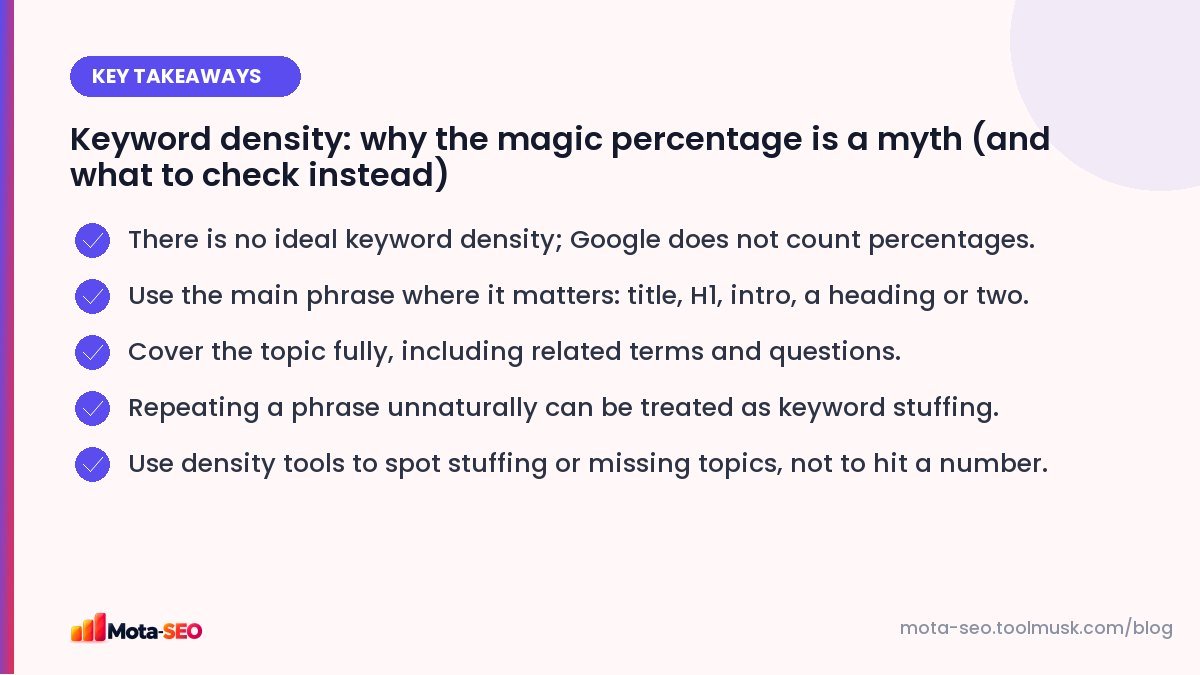
Key takeaways from this guide
Why density doesn't work the way people think
Modern search engines don't rank pages by counting how often a phrase appears. They try to understand what a page is about and whether it answers the search well. Google's systems understand synonyms, related concepts and the meaning of whole passages. A page that says "RO purifier", "water filter for home" and "purification system" is clearly about water purifiers without repeating the exact phrase twenty times.
Google's spam policies explicitly mention keyword stuffing: filling a page with keywords in an attempt to manipulate rankings. Pushing density up can make a page worse, not better.
What does matter about keywords on a page
Placement in the important spots
Use the main phrase, or a close variation, where it carries the most weight and where it reads naturally:
- the title tag (guide),
- the H1,
- the first paragraph or two,
- at least one subheading, if it fits,
- the URL slug,
- image alt text, when it genuinely describes the image.
That's it. After that, write naturally.
Topic coverage
This matters far more than repetition. If you're writing about choosing a water purifier, a thorough page will naturally mention RO, UV and UF, TDS levels, filter replacement costs, water sources, installation and maintenance. Missing those subtopics is a bigger problem than using the keyword 1.2% instead of 2%.
A quick way to find gaps: look at the headings of the top five results for your search, the "People also ask" questions, and the related searches at the bottom of Google's results page.
Matching the searcher's words
If people search "RO water purifier price", the page should actually mention prices. If they search "how to clean RO filter", it should have step-by-step instructions. Matching intent and vocabulary isn't about density; it's about answering the exact question.
How to use a density checker sensibly
Density tools are still useful, just not for chasing a number. Paste your text into our word density counter and look for two things:
- Accidental stuffing. If one phrase dominates the list far beyond anything else, read the text aloud. It probably sounds repetitive. Replace some instances with pronouns or synonyms.
- Missing topics. Compare the most frequent terms on your page with what you'd expect a complete page on the subject to mention. If "TDS" never appears in a water purifier guide, that's a content gap.
What keyword stuffing looks like
Looking for the best water purifier in Delhi? Our water purifier store in Delhi has the best water purifier price in Delhi. Buy water purifier in Delhi today from the best water purifier dealer in Delhi.
Nobody writes like that for people. Compare:
We stock RO and UV purifiers from six brands and install them anywhere in Delhi within 48 hours. Not sure which one you need? Tell us your water source and we'll check its TDS before recommending anything.
The second version mentions the topic and the city once each, sounds human, and actually gives reasons to buy.
Readability beats repetition
A page people read to the end, that answers their question, tends to do well. A page that reads like it was written for a robot tends to lose visitors fast. Check how easy your text is to read with the readability checker, and see our readability guide for practical fixes.
The checklist to use instead of a percentage
- Is the main topic in the title, H1 and opening?
- Does the page cover the subtopics a reader would expect?
- Does it answer the specific questions people search?
- Does it read naturally when spoken aloud?
- Would an expert reading it learn anything?
Get those right and the keyword density will be whatever it naturally is, which is exactly what it should be.
Frequently asked questions
What is the ideal keyword density for SEO?
There is none. Google does not rank pages by keyword percentage. Use the main phrase in key places like the title, H1 and introduction, then write naturally.
Can using a keyword too often hurt rankings?
Yes. Repeating keywords unnaturally is keyword stuffing, which goes against Google's spam policies and makes pages worse for readers.
How many times should I use a keyword in a blog post?
Enough to make the topic clear, typically in the title, H1, introduction and a subheading, and then wherever it fits naturally. Focus on covering the topic fully instead of a count.
Are keyword density tools useless?
Not if used correctly. They are useful for spotting accidental repetition and for checking that important related terms appear, but not for hitting a target percentage.

Written by the Mota-SEO team
We build free SEO and website tools. Our guides are practical, written for small teams, and checked against Google's own documentation.



Comments 0